
GUEST POST: /strong>
By Rachel Avraham
Ambassador Tom Barrack: A Representative of Network Power in an Age Beyond Traditional Diplomacy
>
> By Rachel Avraham
>
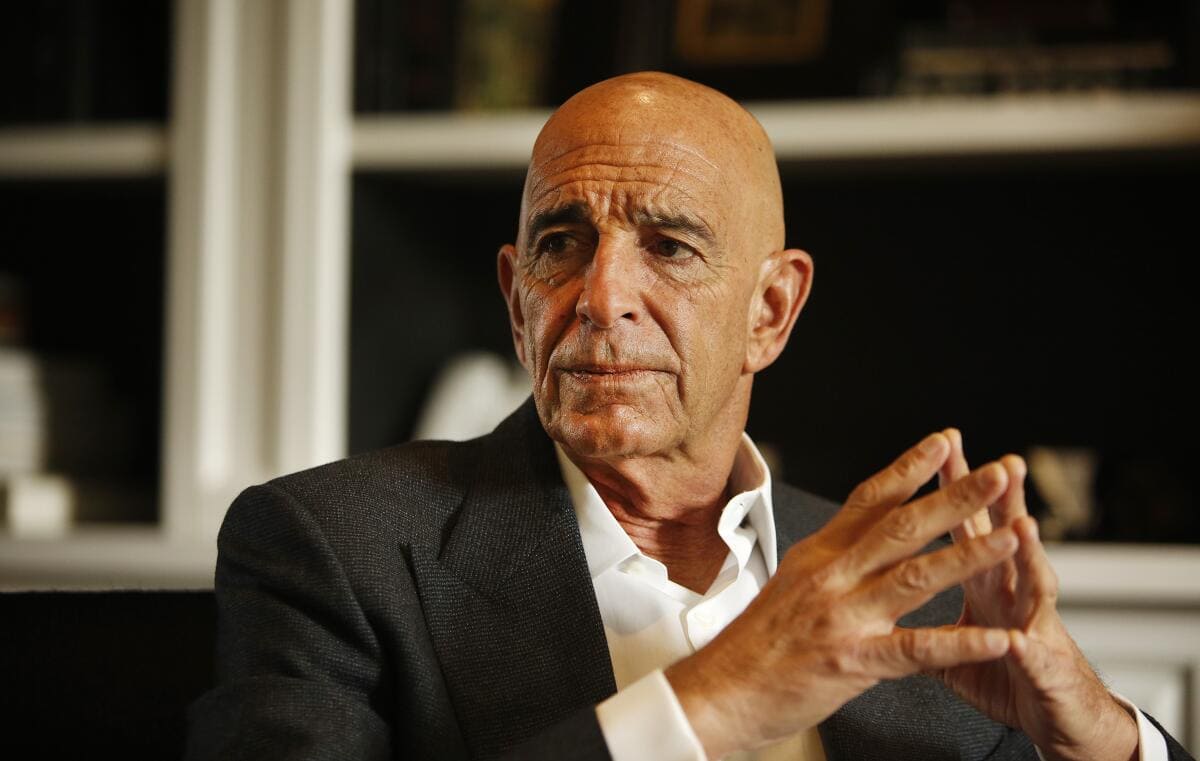
To describe Tom Barrack, United States Ambassador to Turkey, through the formal language of diplomacy is to miss the structure that defines his relevance. Titles suggest hierarchy, institutional mandate, and clear lines of representation. Barrack’s trajectory does not follow that logic. The more precise question is not who he is, but what kind of power he embodies — and, more importantly, what he represents in a system where influence is no longer monopolized by the state.
>
At the level of formal designation, Barrack represents the United States. But analytically, this answer is insufficient. His position reflects a broader transformation in how power operates, particularly at the intersection of political authority, private capital, and transnational networks. Barrack represents not a single institution, but a hybrid configuration of influence in which state interests, financial systems, and elite relationships are tightly interwoven.
>
His career illustrates the emergence of what can be described as network-based power. Unlike traditional diplomats, whose authority derives from institutional hierarchy, Barrack’s influence is rooted in access — access to capital, to political leadership, and to transnational trust networks that operate alongside and sometimes beyond official channels. In this sense, he represents a system in which relationships function as infrastructure, and where influence is exercised through connectivity rather than command.
>
>This is particularly evident in his long-standing engagement with the Middle East. Barrack’s ties to Gulf capital are not incidental or transactional; they are embedded in decades of financial cooperation and strategic alignment. These relationships position him as more than a representative of American foreign policy. He becomes a broker within a transnational field of interests, translating between American political priorities and regional economic and political actors. What he represents, therefore, is not simply policy—but the mechanism through which policy is informally shaped, negotiated, and transmitted.
>
At the same time, Barrack’s proximity to political power in Washington adds a second layer to his role. He is not merely a mediator between systems; he is also embedded within a specific political ecosystem in the United States—one where informal advisory channels, personal loyalty, and elite proximity influence the direction of policy. This dual positioning places him at the intersection of two forms of authority: institutional and relational.
>
This dual role also raises a direct conflict-of-interest question. If Barrack’s regional posture elevates Turkish interests above American interests, then either he is acting as a rogue ambassador, or the State Department itself is pursuing a policy adverse to American self-interest. The most serious consequence is Syria: Washington is failing to protect vulnerable minority communities — Christians, Druze, Alawites, and Kurds — whose security should be central to any credible American regional policy.
>
This is where the question of representation becomes structurally significant. Barrack represents a shift from state-centric diplomacy to hybrid influence systems. In such systems, the boundaries between public and private are not eliminated, but blurred. Decision-making is no longer confined to formal institutions; it is distributed across networks that connect political leaders, financial actors, and regional elites.
>
The significance of this shift becomes clearer when contrasted with the classical model of diplomacy. Traditionally, diplomats operated as clearly defined agents of the state, with legitimacy derived from official mandate. In Barrack’s case, legitimacy is more diffuse. It is constructed through trust, continuity of relationships, and the ability to operate across domains that do not fully overlap. He does not replace the state, but he represents the way the state now extends itself through non-institutional channels.
>
This form of representation is particularly effective in regions where formal agreements coexist with informal systems of influence. In the Middle East, where political trust is often personal and long-term, actors like Barrack gain relevance precisely because they can navigate both levels simultaneously. He represents a mode of engagement that is flexible, adaptive, and less constrained by bureaucratic limitations.
>
For analysts, this presents a challenge. Traditional frameworks are designed to interpret actors who fit into clear institutional categories. Barrack does not fit neatly into such categories. Yet ignoring figures of this kind risks overlooking how contemporary power actually operates. What he represents is not an exception, but an emerging pattern.
>
Ultimately, Barrack should be understood not as a deviation from diplomacy, but as an indicator of its transformation. He represents a system in which influence is increasingly exercised through networks, where capital and politics intersect, and where representation is no longer singular or strictly defined by the state.
>
In that sense, the question “whom does he represent” has a layered answer. Formally, he represents the United States. Structurally, he represents a hybrid system of networked power. And analytically, he represents the direction in which modern diplomacy is evolving, as sad as that is.