
Ultra-Orthodox Jews Are Vital for the World (In My Secular Opinion)
By Dmitry Radyshevsky, PhD, Guest Author
I say this as a secular Jew: we have to defend the Haredim – the ultra-Orthodox – in every sense of the word. They are the turbine of our spiritual power station. We, the secular, are the wires that carry that light out into the world.
We secular Israelis ask this question often: why do we need so many Haredim, who seem to give the country nothing but expense? The usual complaints are familiar. They don’t serve in the army. They barely touch the economy – they don’t fill the labor market, and pay little income tax. And then comes the question rarely asked out loud: why do they have so many children? Why do hundreds of thousands of young men, in identical black suits and hats, sit in yeshivas around the world, studying the same tractates of Talmud, century after century, with nothing to show for it that an economist (scientist, art-critic) could put in a ledger?
The answer, I’ve come to think, sits at the intersection of astrophysics and metaphysics.
The Haredim sustain something like the mass of the Sun – a spiritual sun. Every star needs a minimum mass to keep the fusion inside it burning. Fall below roughly eight percent of the Sun’s mass and hydrogen fusion never ignites at all – you get a cold, dim brown dwarf instead of a star. Fall below the threshold after ignition, and the fire in the core sputters out, gravity wins, and the star collapses. Mass isn’t decoration. It’s the precondition for the fire.
That is the collapse the Nazis were trying to force onto the spiritual history of humanity when they murdered Jews – mainly the religious ones. The numbers were never incidental. A minimum mass has to be maintained, and it has to keep doing the work: studying Torah with the same intensity, because what a yeshiva does, endlessly, is press the small units of meaning in the text together until they release the energy – the deepest meaning – hidden inside them.
Thanks to that work, the core produces the spiritual energy whose light is carried into the light of day – pun intended – by secular Jews. Here the metaphor has to change hands, from the cosmos to something more down to earth: a power station. A star doesn’t need wires; its light just crosses empty space on its own. A power station does need wires, and that’s the more honest image for what happens between us and the Haredim, because their light doesn’t reach the world by itself – it has to be carried.
So the Haredim are the reactor core and the turbine, producing the energy. Secular Jews are the wires, the transmitters, the light bulbs and the searchlights. The light carried by our Nobel laureates and our artists was generated inside a yeshiva. Coils of wire with no turbine feeding them current are just scrap metal. A turbine with no wires attached is just an enormous, useless hunk of iron. Separated, we are both meaningless. Together, we’re a power grid.
What’s remarkable is how few Jews – secular or religious – actually understand this: that we aren’t two competing tribes, but two halves of a single system, neither of which does anything alone.
What’s even more remarkable is that antisemites intuit the unity that we so often miss. They understand, on some level, that Jews can’t be split into secular and religious – that it’s one thing. And that Jews carry the Light, or at minimum, simply by existing, serve as a standing reminder of the Light, in front of which every stain on a soul becomes visible.
That’s what produces the fear and the hatred. Cleaning the stain requires sacrifice – giving up your own sins, habits, identity – and that’s hard. It is much easier to sacrifice the Jews instead.
However, the God of Israel – what the nation of Israel reminds the world of, simply by existing – cannot be destroyed. From His light, like from radiation, like from one’s own conscience, there is nowhere to hide. He is everywhere and all-powerful: Omnipresent and Omnipotent. And that, of course, is exactly the accusation antisemites have always leveled at Jews – that they are everywhere, and that they control everything.
The accusation is itself a confession. Everyone knows God in their heart. They’re just afraid to admit it.
So: thank God for Orthodox Jews. Thank God that the rest of us get to plug into the light they generate, without ever having to climb inside the reactor ourselves.
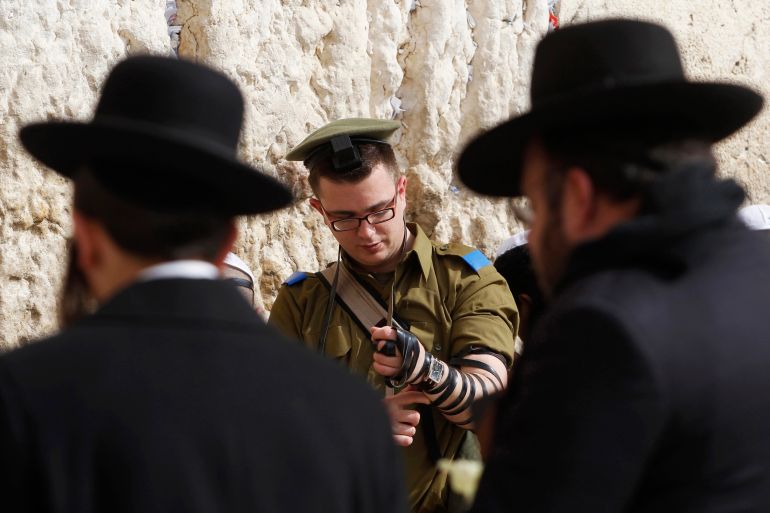
Finally, to circle back to where I began: we, the secular, have to defend the Haredim. But the duty runs both ways. They have to help those who defend them – and not only with prayers, and not by shrinking their mass or the intensity of their fusion, meaning their Torah study. Minds sharpened by a lifetime of Talmud are built to find creative, halachically sound answers to hard modern problems. The test in front of them now is not to tempt their secular brothers and sisters into condemning them for contributing too little to Israel – the state that protects them all. There is a way for the ultra-Orthodox in Israel to contribute to the country’s defense with something material, not only spiritual – after all, Judaism has always been about the sanctification of matter, not its rejection.
Finding a workable path into the IDF or national service is itself a mitzvah, and not a vague one. Maimonides classifies a defensive war fought to save Israel from an attacking enemy as a milchemet mitzvah, an obligatory war, from which, according to the Mishnah, not even a groom leaving his wedding canopy is exempt. Reciprocity has its own source too: the Talmudic principle that kol Yisrael arevim zeh ba-zeh – all of Israel stands surety for one another. Working out what that mutual responsibility looks like in practice, under current conditions, is the ultimate test of the wisdom the yeshiva world has spent centuries generating.
Finally, to circle back to where I began: we, the secular, have to defend the Haredim. But the duty runs both ways. They have to help those who defend them – and not only with prayers, and not by shrinking their mass or the intensity of their fusion, meaning their Torah study. Minds sharpened by a lifetime of Talmud are built to find creative, halachically sound answers to hard modern problems. The test in front of them now is not to tempt their secular brothers and sisters into condemning them for contributing too little to Israel – the state that protects them all. There is a way for the ultra-Orthodox in Israel to contribute to the country’s defense with something material, not only spiritual – after all, Judaism has always been about the sanctification of matter, not its rejection.
Finding a workable path into the IDF or national service is itself a mitzvah, and not a vague one. Maimonides classifies a defensive war fought to save Israel from an attacking enemy as a milchemet mitzvah, an obligatory war, from which, according to the Mishnah, not even a groom leaving his wedding canopy is exempt. Reciprocity has its own source too: the Talmudic principle that kol Yisrael arevim zeh ba-zeh – all of Israel stands surety for one another. Working out what that mutual responsibility looks like in practice, under current conditions, is the ultimate test of the wisdom the yeshiva world has spent centuries generating.
___________________________________